
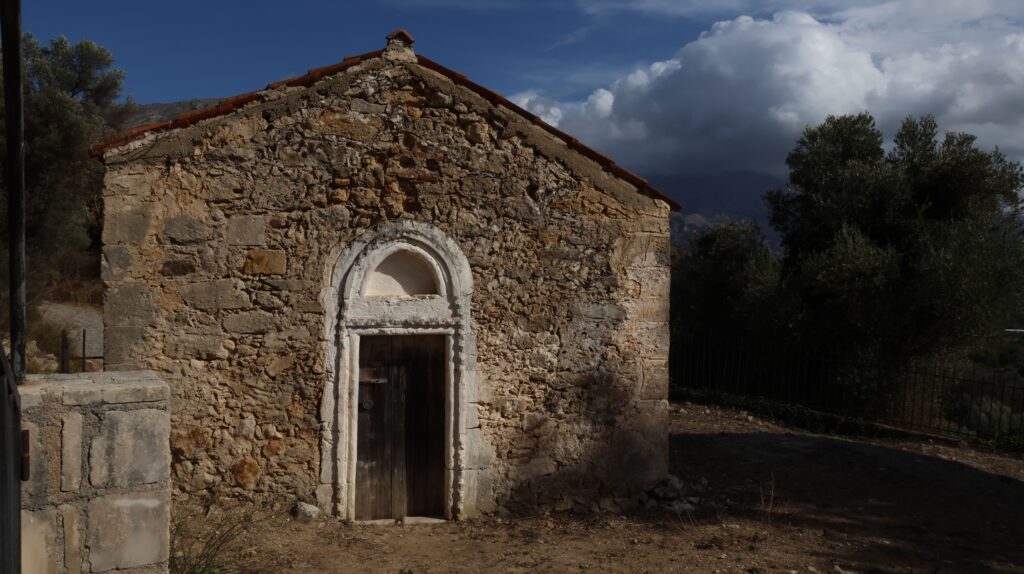
The little church of Agios Onouphrios is dated 1329 AD. We know the date because of a written dedication inside, on the West wall. At first glance, the church doesn’t look very special. But then, when you take a closer look …
It’s a simple, small, aisleless barrel-vaulted church, constructed on an East-West axis with with the sanctuary and altar at the eastern end and the principal entrance in the western wall. This was not accidental architecture, it reflects theology, liturgical practice, cosmology, and is inherited from earlier Christian tradition. The symbolism of this set-up was that important that two of the most important theologians in Christian history, Basil the Great (Agios Vasilios) and John of Damascus discussed it explicitly.
This church by the village of Genna has some exquisite frescoes in it, some of which are in good condition.
But the architecture itself paints a story of possible more ancient origins. The dedication next to the doorway gives October 1329 as a date, but it is not certain that this marks the original construction of the church itself. Reading the building carefully, there is a highly plausible alternative interpretation.
We know that Crete suffered severe destruction during the great earthquake of 8 August 1303. Seen in that context, the date of 1329 could defensibly represent a major reconstruction or repair phase rather than the original foundation of the church.
One of the strongest clues is the doorway itself. Stylistically, the dressed exterior surround appears considerably later than the fourteenth century. Its proportions and composition point more convincingly toward a late fifteenth- or early sixteenth-century Venetian Renaissance intervention.
Above the doorway, however, the wall preserves traces of a much older decorative tradition. The circular recesses arranged in a cross-like composition, framed with flat brickwork, are the remains of what are known as bacini — glazed ceramic bowls inserted into church façades as decorative elements. This practice is strongly associated with Byzantine and medieval Mediterranean ecclesiastical architecture and may indicate that parts of the western wall preserve significantly earlier fabric.
The doorway becomes even more revealing when viewed from inside the church. Here it is clear that the dressed exterior portal has been inserted against an earlier structural opening. The heavy internal lintel and the surviving impost-like stones above the door appear to belong to an older architectural phase entirely. Taken together, the evidence strongly suggests that the church underwent multiple stages of structural adaptation over the centuries, one major phase of which may well be the reconstruction recorded in 1329, possibly following earthquake damage to an earlier Byzantine structure.
This little gem has a few more surprises in store for us. Structurally, two striking features immediately stand out inside. The first and most obvious one is the templon, the dividing wall separating the bema (βῆμα), or sanctuary, containing the altar, the apse and the liturgical space reserved for the clergy, from the nave, the principal worship space for the faithful. The opening connecting the two spaces is known as the Beautiful Gate or Royal Door.
What makes this church particularly unusual is that this dividing screen is still a masonry wall rather than the more familiar later wooden iconostasis found in most Orthodox churches today.
That fact, together with a closer look at the stonework of the wall, clearly visible from the sanctuary side, suggests that this may well be a surviving feature of a much older Byzantine church that underwent several later phases of rebuilding and modification, one of which is recorded by the inscription dated 1329.
The second feature is the interior transverse reinforcing arch.
And then, there are the frescoes which reveal that the church is far more intellectually and spiritually sophisticated than its tiny size would suggest. At first they seem like randomly placed scenes from the new testament and a collection of saints who fill wall space. Nothing could be further from the truth.
The fresco programme of Agios Onouphrios is far more sophisticated than the size of the church would initially suggest. Like the architecture itself, the paintings reveal a carefully ordered Byzantine theological world.
Above the entrance survives a heavily damaged Koimesis, the Dormition of the Virgin, an appropriate image for a church serving the village graveyard. From the very moment of entry, the themes of death, intercession and salvation are already present.
Along the nave walls unfold scenes from the life and Passion of Christ: the Baptism, the Raising of Lazarus, the Entry into Jerusalem, the Last Supper, the Betrayal and the Crucifixion. Together they form the earthly story of Christ visible to the congregation gathered in the nave.
But as we move eastward through the church, the programme changes. Around the great transverse arch and the area before the templon appears an extraordinary concentration of healing and protective saints. Female martyrs such as Saint Barbara, Saint Marina, Saint Paraskevi and Saint Anastasia Pharmakolytria occupy the arch itself, while the surrounding walls contain healer saints including Panteleimon, Cosmas, Damian, Cyrus and Hermolaus. This is not random decoration. The church gradually shifts from sacred history toward intercession, healing and spiritual protection.
Beyond the templon lies the sanctuary itself, the most sacred part of the church. Here the imagery becomes increasingly liturgical and theological. Prophets, bishops and church fathers surround the altar space, culminating in the Annunciation, the Mandylion and the great Deësis: Christ flanked by the Virgin and John the Baptist in eternal intercession for humanity.
The entire interior functions almost as a spiritual journey. The faithful enter through images of mortality and salvation, pass through the earthly life of Christ, move beneath the protection of saints and healers, and finally arrive symbolically before the divine mysteries of the sanctuary itself. Even in this tiny mountain chapel, the full cosmological and theological structure of the Byzantine church is present.
