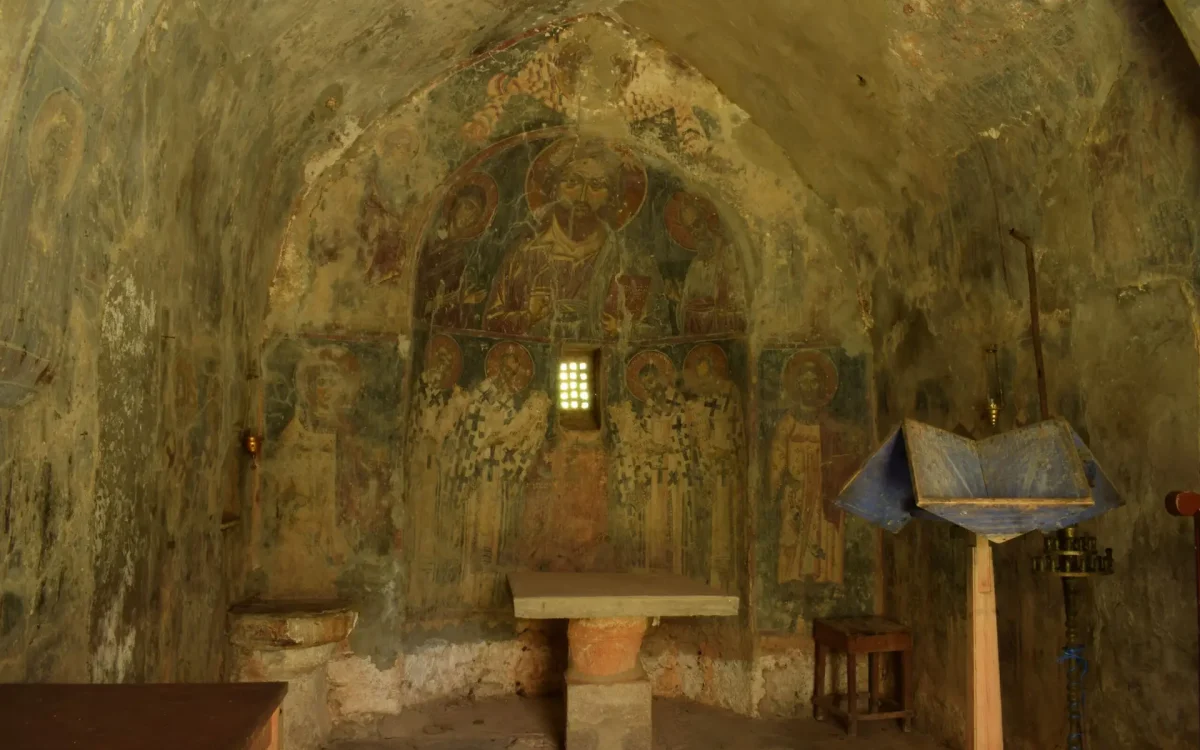

Most people step into a church and see the sanctuary as a piece of architecture: a curved end wall, an altar, some paintings, a screen. Very few ever ask why it is shaped the way it is, why those particular images are there, or why the space feels so different from the rest of the building. Yet nothing in a Byzantine sanctuary is accidental. Every line, surface, and figure belongs to a long story about sacrifice, authority, presence, and the meeting of heaven and earth.
Long before Christianity, the altar already existed as one of humanity’s oldest points of contact with the unseen. In the ancient Mediterranean world it was a stone or earthen structure raised slightly above the ground, open to sky and weather, marked by fire and blood. The altar was not a god and had no will of its own, yet it was treated as sacred and inviolable because it was the place where life was offered upward. Blood spilled on its surface was believed to cross a boundary between the human and the divine. Sacrifice was not symbolic. It was physical, costly, and final.
Greek myth itself placed enormous weight on the altar as a place of binding truth. According to ancient tradition, before the Olympian gods rose to power, Zeus and his allies swore an oath at an altar before taking on the Titans. That altar, later remembered as the celestial Ara, became the place where cosmic order was sealed. What mattered was not the altar as an object, but what happened upon it: an irreversible commitment, made sacred through blood and fire, that determined the fate of the world. Even when the altar was lifted into the heavens as a constellation, its meaning remained unchanged. It was the place where violence, oath, and order were bound together.
As Greek and Roman religion developed, this logic hardened. Animals were slaughtered, blood poured, smoke rose. The altar functioned as a threshold. Humans acted below, gods remained distant above, and sacrifice bridged the gap. The gods did not give themselves. They were appeased.

Early Christianity did not reject the altar as an idea. Instead, it overturned its meaning. The Christian claim was not that sacrifice was wrong, but that it had been fulfilled once and for all. The death of Christ was understood as the final and complete offering, freely given rather than violently extracted. Sacrifice no longer meant repeated killing in order to maintain order. It meant participation in a single, eternal act of self-giving that had already restored order.
This change made it possible for the altar to move indoors. No longer exposed to sky and fire, it entered the church and became the holy table. Yet it remained an altar, because something was still offered there. Bread and wine replaced blood, but they were not chosen because they were harmless. Grain is crushed, grapes are pressed. Creation itself bears the cost. What changed was not the seriousness of sacrifice, but its direction. No longer did humans reach upward through blood. God now descended through gift.
As Christianity spread, the space around the altar changed with it. The sanctuary emerged as a distinct zone, set apart not by danger or fear, but by holiness. In Byzantine churches this space was oriented to the east, toward the rising sun and the promise of resurrection. The sanctuary became symbolic geography. Heaven was imagined as ordered and hierarchical, and the sanctuary was shaped to mirror that order on earth.
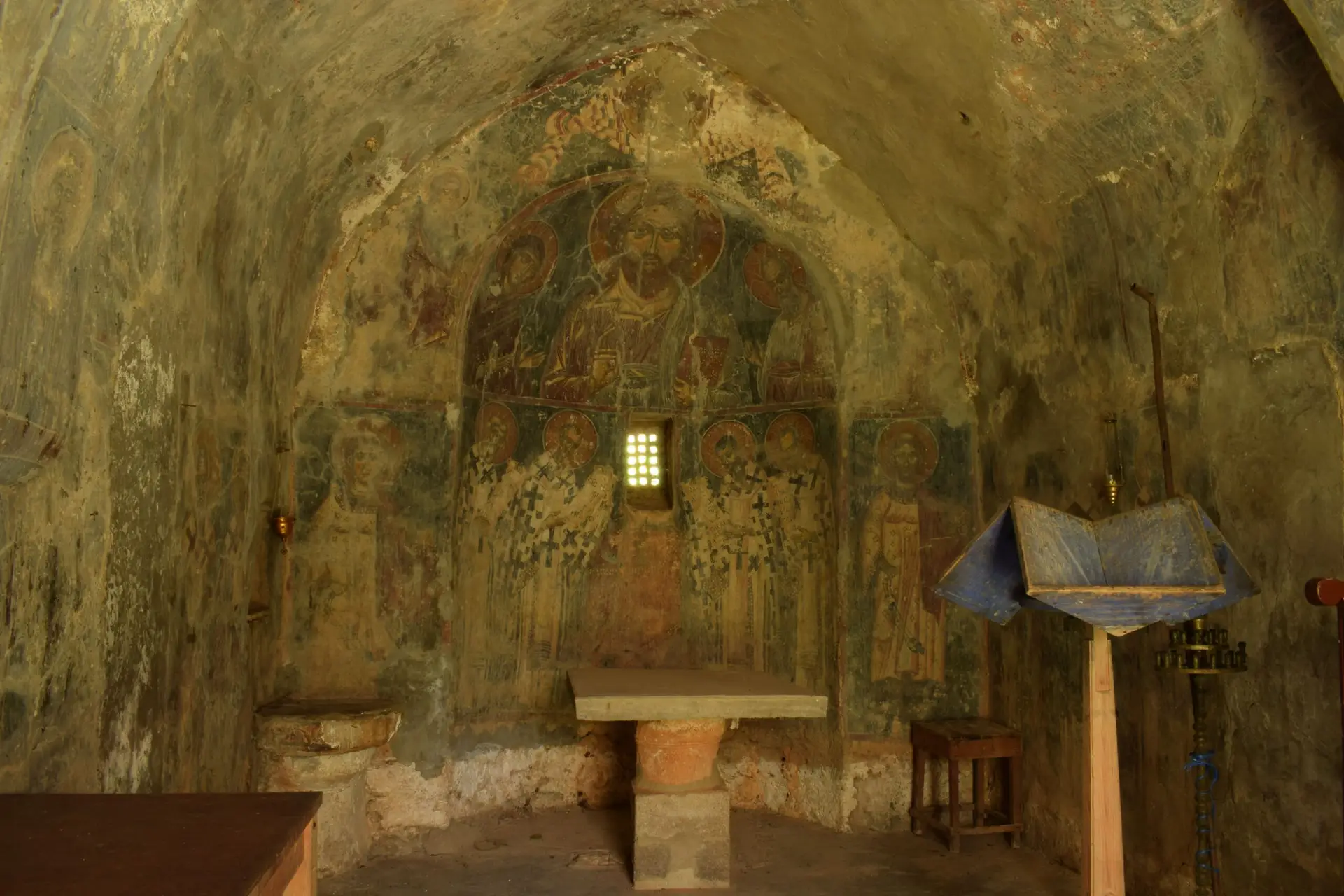
The curved apse formed the heart of this space. Its shape echoed the vault of heaven itself. A flat wall would have closed the church off. The curve suggested openness, continuity, and descent. The sky no longer remained distant above. It bent down toward the altar. The altar stood before the apse as the place where heaven and earth now met, not through violence, but through presence.
In many ancient Cretan churches, the semi-dome above the apse carries the Deesis: Christ Pantocrator flanked by the Virgin Mary and John the Baptist. Pantocrator, ruler of all, occupies the centre because the sanctuary is ultimately focused on him. He is shown as judge and sustainer of the cosmos, the one before whom the final accounting will take place. Yet he is never shown alone. On either side stand the two greatest intercessors. The Virgin represents humanity at its most receptive, the one who consented to the Incarnation and who embodies the Church offering itself back to God. John the Baptist represents prophecy and repentance, the final voice pointing directly to Christ. Together they form a permanent plea for mercy. Placed above the altar, this image makes clear that the Eucharist is not only a sacred meal, but an encounter with divine judgement approached through compassion.
Within the apse itself, Cretan churches often move from intercession to offering through the Melismos. Christ is shown as a newborn child lying on the altar, with bread and wine beside him. He is flanked by officiating hierarchs, most often Basil the Great and John Chrysostom, whose names are attached to the Divine Liturgies still celebrated today. This image is not narrative and not sentimental. It states a theological truth. Christ is incarnation and sacrifice at once. The child replaces the victim. Vulnerability replaces violence. The hierarchs do not kill; they receive and distribute. The priest standing at the altar below steps into a liturgy already shown to be complete.

Around this, bishops and Church Fathers appear, anchoring the mystery in continuity and tradition. The sanctuary becomes a visual hierarchy: Christ enthroned above as judge approached through mercy, Christ offered below in the Eucharist, and the Church surrounding the act with memory and authority.
The triumphal arch framing the apse carries the story outward. In ancient Cretan churches it often bears the Philoxenia of Abraham, the welcoming of the three angels. This is not simple hospitality. It is the recognition of God hidden within the ordinary. Placed at the threshold of the sanctuary, it teaches that divine presence is revealed only to those who receive without resistance. Sometimes the Annunciation appears instead or alongside it, because it marks the moment when heaven entered the world not by force, but by consent. Mary’s yes is the beginning of the sacrifice fully revealed in the apse.
On the flanking walls of the sanctuary stand figures who show how the liturgy is lived. On the left stands Saint Stephen, the deacon and first martyr. The left side is associated with service, and Stephen appears holding a censer, clothed in white for purity and red for martyrdom. He stands closest to the altar because he embodies service carried to its ultimate offering. On the right stands Romanos the Melodist, representing praise, proclamation, and sung theology. Where Stephen serves through action and sacrifice, Romanos serves through word and hymn. Together they show that the liturgy is completed through both offering and praise.
Seen in this light, the Byzantine sanctuary is not simply architecture. It is a transformation of one of humanity’s oldest ideas. The altar that once bound the gods through blood now proclaims a gift freely given. The place where Zeus and the Olympians swore an oath before violence became, in Christianity, the place where violence ends. Heaven no longer waits above. It bends, quietly and deliberately, into stone, paint, and presence.