
Once, long before the villages we know today, the high hill known as Kastri bore a settlement perched precariously against the sky. Its stones gleamed in the sun, arranged not with the precision of palaces, but with the care of people who built for shelter and survival, for their lives were not governed by kings or courts, but by the whims of fate and the shifting tides of the world around them. This was a time after the great palatial order of Crete had crumbled, when the ancient Minoan world was fracturing, and those who had once depended on stability and hierarchy now found themselves adrift. Bands of former soldiers and desperate men roamed the seas and the lands, and the people of Crete learned to watch, to listen, to protect what little they could.
For several generations, the settlement thrived in its quiet dignity. Families tilled the terraces, collected water from the cisterns, and hunted the rugged hills. They were neither rich nor powerful, but they were watchful and cautious, placing their homes strategically upon the slopes where the view allowed no stranger to approach unbidden. And in the evenings, they gathered by flickering fires to tell their stories, stories of the old palaces and the gods who once walked among men, of the seas that had carried traders and treasures alike, and of the winds that could turn the world upside down without warning.
Yet, time is not kind to even the most vigilant. The settlement on Kastri, though careful and wise, could not withstand the inexorable march of history. Within a few generations, the new order of Crete, the slowly coalescing social and political arrangements that followed the collapse of the palatial system, took root across the island. Trade routes shifted, alliances formed, and the once-prized vantage of Kastri became a quiet overlook, important no longer for defence but only for memory. Families began to drift away, seeking more fertile plains, safer valleys, and neighbours who could promise stability. And so Kastri’s life, vibrant and steadfast for a brief era, began to wane.
From the remnants of this decline arose a smaller, more modest settlement on the hill, one which the villagers in time would call Vokrou. It lacked the energy and prominence of its predecessor, but it persisted, a stubborn cluster of homes clinging to the heights where their ancestors had once looked out over the land. The people of Vokrou tilled the remaining terraces, planted their olives and barley, and gathered the meagre produce of the hills. Life was hard, but in hardship, they found rhythm and endurance. And yet, as always, fate had more in store.
Centuries passed, and the plague — that relentless shadow of death — swept through the hills and valleys of Rethymno. It did not distinguish the strong from the weak, the clever from the foolish. In Vokrou, it struck without mercy. Houses that had echoed with laughter were suddenly silent. Fields lay fallow. The olive trees, witnesses to generations, swayed over empty doorways. From the once-thriving settlement, only a handful survived: among them, a mother, weary from loss and sorrow, and her son, who had barely come of age. Alone, bereft, they left Vokrou, carrying nothing but the clothes on their backs, the memories of ancestors, and a quiet hope that life could continue somewhere else.
As they descended the hill, the mother and her son stumbled upon an area near a gentle stream, where the land opened into a small plain flanked by green hills. There, lying in the shade of a myrtle bush, they discovered something that would forever change the story of this place: an icon of the Panagia. Its paint was faint with age, but the image radiated a light that seemed to hum softly in the air around it. The son, feeling a strange and sudden reverence, took it in his hands, intending to bring it with them to wherever they might settle. But when night fell and the stars rose over the hills, the icon was gone, returning as if of its own will to the myrtle bush where it had first been found.

At first, the mother laughed, calling it a trick of the wind or the shadows. But the next day, the same thing happened. The boy moved it, yet it returned. And so it continued, day after day, until they understood — not with their minds, but with the quiet certainty of hearts — that this was no ordinary object. The icon had chosen its place, and the place had chosen them. Here, they would plant the seeds of their new life.
Together, mother and son cleared a small area around the bush, constructing a simple shelter for themselves and a modest chapel for the icon. They carved beams from nearby trees, fashioned a roof of thatch, and inscribed the walls with prayers and thanks. The icon presided over the humble sanctuary, its presence a reminder of resilience, of the continuity of life even after the cruelties of disease and time. Neighbours and wandering villagers, hearing of the miraculous image, began to gather. Some came to pray; others to help build, to plant, to settle. The new community grew slowly, its rhythm dictated by the seasons, the water, and the slow accumulation of lives that chose to stay.
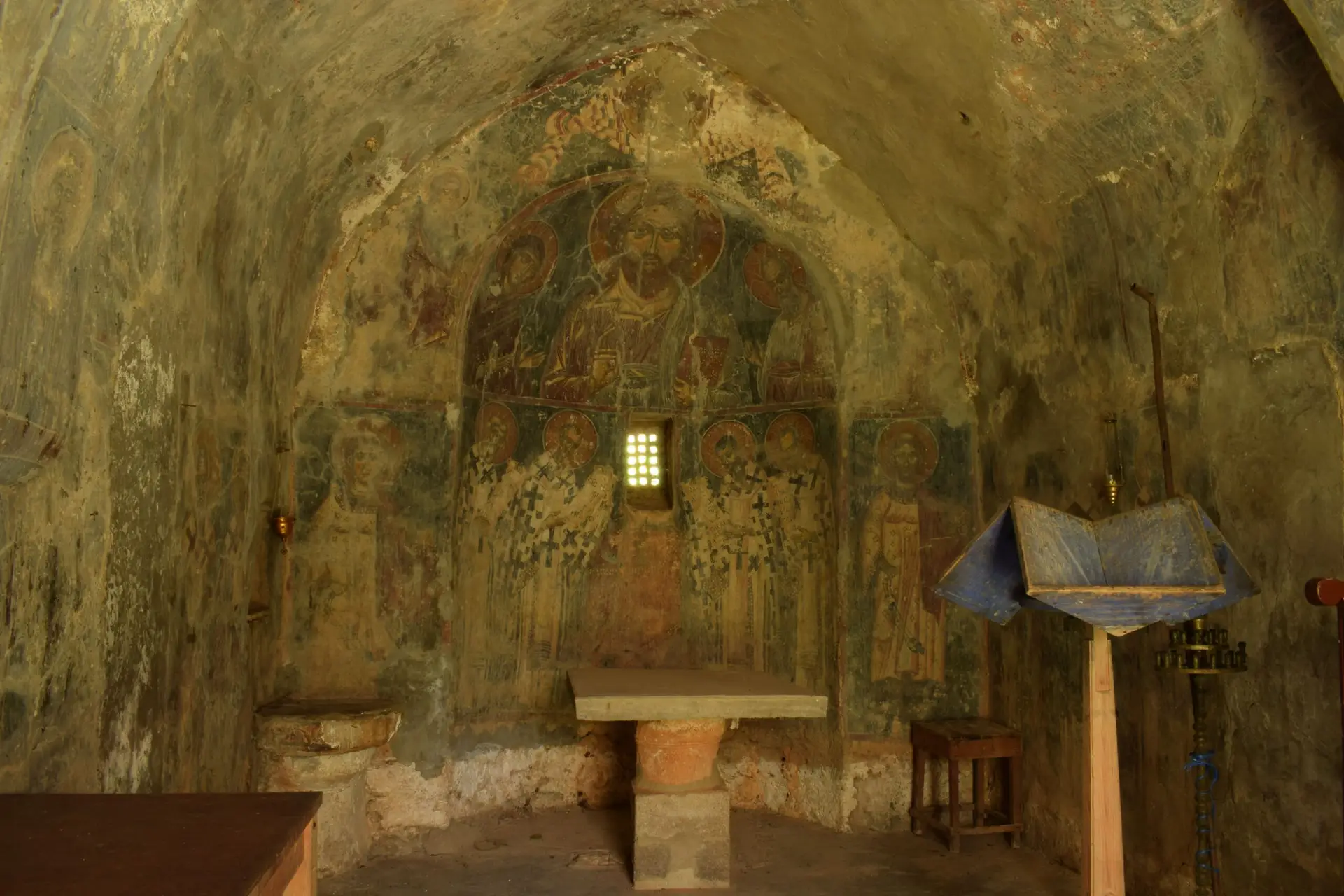
The settlement came to be known as Prasses, its name whispered in the hills as the home of the miraculous Panagia Myrtidiotissa, the Virgin of the Myrtle bush. The small church by the graveyard is still, today, referred to as the church of the Panagia Myrtidiotissa. The story of the icon became intertwined with the village’s identity, embroidered by each telling, each devotion, each festival. Over time, embellishments arrived: the icon was said to glow by moonlight, to guide travellers who had lost their way, to shed tears when disaster loomed. The villagers told these stories not as lies, but as ways to explain the world, to understand suffering and survival, to lend significance to the mysteries of life. In Crete, as in all places touched by the divine imagination, the stories were inseparable from faith.

Generations came and went, each adding their own strokes to the mural of Prasses’ history. Festivals were held, prayers offered, children christened beneath the gaze of the miraculous image. Travelers passed through and carried the story to distant towns, embellishing it further: a mother and son alone, fleeing disaster; an icon that would not be moved; a settlement that rose from ashes and sorrow. And though the tale might never match the facts exactly, it did not matter — for in the telling, the people find continuity, purpose, and a connection to the generations that came before.
In later centuries, Prasses took on a new life under Venetian rule. The village, once humble and fragile, flourished with the influx of trade, the protection of Venetian governance, and the industriousness of its inhabitants. Elegant houses rose, their walls built with care and vision, their windows and doors carved with artistry, standing testament to the skill and prosperity of the people. Today, those beautifully renovated Venetian homes, some still inhabited, some lovingly preserved, whisper of a time when Prasses became not only a place of survival but a beacon of culture and continuity. The village, shaped by calamity and faith, now bore the imprint of Renaissance elegance and civic pride, the miraculous icon still at its heart, bridging centuries of human endeavour, devotion, and resilience.
And so the story of Prasses is a living tapestry: Kastri, Vokrou, the plague, the miraculous Panagia, the Venetians and the Ottoman, all layered together, each leaving its mark on the land and on the people. In Prasses, the past is never truly gone — it stands in stone and story, in prayer and festival, in the sturdy walls of homes that survived centuries. From the high hill of Kastri to the gentle plain below, from the shadows of Vokrou to the church and village that grew in faith and hope, the people of Prasses remember, celebrate, and endure. Their story, like the village itself, is timeless, resilient, and radiant, a testament to survival, devotion, and the enduring beauty of human creativity and belief.

Kastri, the steep hill rising above the village of Prasses in Rethymno, is today dominated by an almost inaccessible Ottoman koules, yet the slopes immediately below the summit preserve traces of a much earlier phase of activity. A series of low, dry-stone wall segments, constructed of small irregular fieldstones without mortar, appear on the upper approaches to the peak. Their form, orientation, and spatial patterning do not correspond to the known Venetian or Ottoman installations on the summit, nor do they resemble the characteristic agricultural terraces of the early modern period. Instead of contour-following terraces or coherent fortification lines, these walls run in straight or slightly curving alignments that radiate downslope, subdividing the hilltop into wedge-shaped compartments. Their eroded condition and seemingly purposive but non-defensive layout raise the possibility that they belong to a prehistoric occupation, perhaps dating to the Late Minoan IIIC or Early Geometric period, when hilltop refuge settlements proliferated across Crete.
Comparable features are known from several well-studied sites of the post-palatial era. The refuge settlement of Kastellos near Orne presents the closest morphological parallel. There, too, the slopes beneath a rugged, defensible peak are segmented by straight, discontinuous walls that do not form a perimeter but instead organize the internal space of a small, temporary community. Similar observations have been made at Karphi on the Lasithi Plateau, where the LM IIIC settlement comprises a loose web of interior partitions that articulate domestic areas, create sheltered niches, and modulate circulation across a steep and uneven summit. Smaller refuge sites such as Monastiraki Katalimata exhibit the same architectural logic: short lines of dry-stone walling run upslope to anchor dwellings, delineate household compounds, and carve level platforms out of rugged terrain. The Kastri walls share this morphological vocabulary, suggesting an analogous function within a constrained summit settlement.
Interpreted within this framework, the radial layout at Kastri is best understood as a system of internal organization rather than as a defensive structure in its own right. The walls may have served to retain small habitation platforms, to demarcate spatial sectors used by different households, or to create sheltered working areas exposed to frequent winds. Although not fortifications, such partitions also had tactical implications, potentially complicating movement across the upper slopes for any assailants who reached the settlement. This multifunctionality is characteristic of the pragmatic architecture of the twelfth to tenth centuries BCE, when communities adopted hilltop refuges in response to political fragmentation and insecurity following the collapse of the palatial system.
A later date is unlikely. Venetian agriculture relied on larger stones and followed natural contours, while Ottoman construction at the summit employs mortar, geometric planning, and clear defensive logic. None of these later traditions produce the radial, segmented pattern visible at Kastri. Although definitive dating must await ceramic evidence or excavation, the structural morphology itself aligns most closely with the architectural habits of LM IIIC–Early Iron Age refuge sites.
If this interpretation is correct, Kastri may represent an early settlement nucleus that preceded later historical occupation in the region. Its presence would place Prasses within the broader pattern of upland refuges that shaped the demographic landscape of post-palatial Crete. The surviving walls thus stand not only as archaeological remnants but as possible material anchors of long-term local memory, connecting the modern village to deep cycles of habitation, abandonment, and reoccupation on this commanding hilltop.