
The history of the Emirate of Crete is one of the most fascinating chapters in the medieval Mediterranean. It is a story of exile, migration, maritime daring, imperial determination and the encounter between two worlds: the Muslim societies that expanded across the western and central Mediterranean, and the Byzantine Empire striving to preserve its dominion over the Aegean. Crete, known in Arabic sources as Iqrīṭish, became the unlikely focal point of this encounter during the ninth and tenth centuries. The island was both a refuge for Andalusī dissidents and adventurers, and a strategic target for the Byzantine state. The Arabic and Byzantine sources that describe this period do not always agree, and each tradition preserves its own emphasis and its own silences. Yet taken together, they allow us to reconstruct the rise, life and fall of the Emirate of Crete with remarkable clarity.
According to the Arabic geographers, Crete entered the world of Islam in dramatic fashion. In the early ninth century, groups of Andalusī Muslims—possibly rebels, possibly refugees, certainly seasoned seafarers—departed from al-Andalus and eventually seized the island. Arabic writers remembered them as wanderers in search of a new home after leaving Iberia. The tenth-century historian and geographer al-Masʿūdī wrote that the people of al-Andalus “took the island of Crete as a refuge after their departure,” establishing an emirate whose inhabitants were known for their skill in fighting and their mastery of the sea. This memory of displacement and resettlement reappears in later Andalusī literature, which often portrays the settlers of Crete as a proud, martial diaspora, a seaborne extension of their homeland.
The Arabic geographers of the tenth century provide a consistent picture of the island under Muslim rule. Ibn Ḥawqal, one of the most important of them, describes Crete as a large and prosperous island, abundant in goods, hosting merchants, and yielding profitable trade. More important, he emphasises that it was “a meeting-place of men of jihad who raid the people of the Romans and who harm their coasts.” In his eyes, Crete was not simply an agricultural or commercial centre; it was a forward base of maritime war. Al-Isṭakhrī, another geographer, echoes this, noting that the people of Crete were “raiders, numerous of ships, and they fight the Romans on the sea.” These brief descriptions reveal a great deal about how the island functioned. It was part of a maritime frontier, one of a chain of islands that facilitated raids, provided harbours for ships, and offered safe havens for seafaring communities engaged in the ongoing conflict between Byzantium and the Islamic world.
The Arabic sources do not offer detailed information about the internal government of the emirate. Rules of succession, taxation and local administration are largely absent. What they do emphasise—uniformly—is the island’s identity as a community of seafarers and warriors. The Andalusī writers Ibn Ḥazm and Ibn al-ʿAbbār preserve a memory of the Cretan Muslims as ferocious at sea, adept at raiding, and capable of defeating any force that opposed them. Such praise, though stylised and shaped by community memory, suggests that the emirate’s Andalusī identity remained vivid even after decades in the eastern Mediterranean. To later Muslim writers, the Cretans were heirs of Andalusī courage and naval prowess.
Warriors of the Middle Sea: The Two-Century Struggle for Crete
If the Arabic tradition dwells on the emirate’s maritime character, the Byzantine sources approach the island from a different angle. To the Byzantines, Crete was first and foremost a security threat and a challenge to imperial authority. The chroniclers describe an era in which Cretan raiders appeared unpredictably along the Aegean coasts, striking at towns, villages and shipping routes. The empire’s inability to eliminate this danger for more than a century made the island a symbol of Byzantine vulnerability. The establishment of a Muslim emirate on Crete had created a hole in the imperial defensive system, and recovering it became a long-standing military priority.
Byzantine writers have little to say about the origins of the emirate or the daily life of its inhabitants. Their interest lies almost entirely in the campaign that brought Crete back under imperial control. That reconquest, carried out in 960–961 by the general Nikephoros Phokas, is recounted in detail by Leo the Deacon, one of the most vivid narrative historians of the tenth century. Leo describes how Nikephoros assembled a formidable army and a fleet of siege engines, transported them across the sea, and encircled the island’s capital, Chandax (modern Heraklion). The siege was prolonged and bitter. The defenders fought desperately, and the Byzantines deployed every device available to them. Ultimately, Nikephoros ordered the construction of an enormous mound reaching the walls, allowing his troops to breach the city’s defences. When Chandax fell, Leo describes a scene of slaughter, captivity and plunder. To him, the reconquest was a moment of liberation: the island was “freed from the Saracen yoke.”
The poem of Theodosios the Deacon, written shortly after the conquest, transforms the event into a moral and religious drama. It describes the fall of the emirate as the just punishment of God for the island’s opposition to the Christian empire. This rhetorical framing was common in Byzantine celebratory literature, but it also shows how the reconquest was not only a military achievement but a symbolic one, confirming Byzantine strength after periods of doubt.

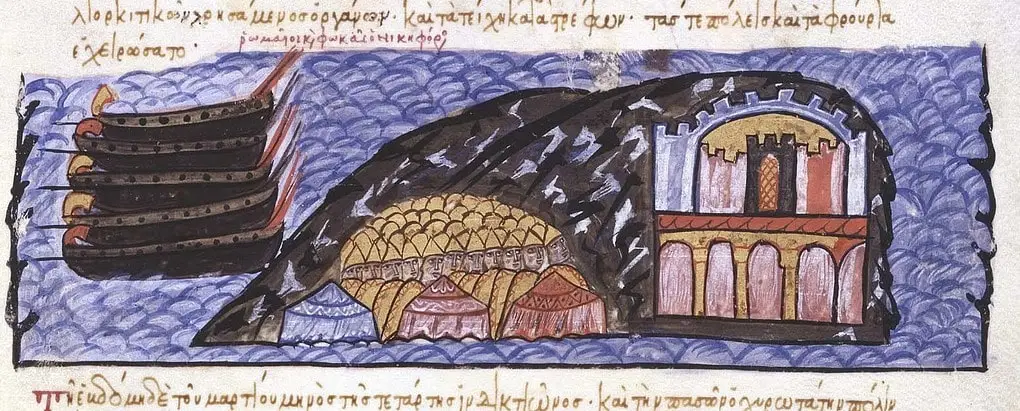
Later Byzantine chronicles, such as the works of John Skylitzes and the continuations of Symeon the Logothete’s chronicle, repeat and expand on Leo’s narrative. Medieval illustrators even depicted the siege in lavish miniatures in the famous Madrid Skylitzes manuscript. In the Byzantine imagination, the reconquest of Crete became a defining moment of imperial resurgence.
Comparing the Arabic and Byzantine accounts reveals both contrasts and complementarities. The Arabic writers focus on the island’s role within the Islamic world: a settlement of Andalusī refugees, a base for jihad at sea, and a community defined by its mobility and martial identity. The Byzantine writers focus on the threat Crete posed and on the dramatic restoration of imperial authority. The former tradition begins with origins, the latter with endings. The Arabic texts see the island’s story outward, through the eyes of diaspora and frontier; the Byzantine texts see it inward, through the eyes of empire and security.

“A heavily illustrated illuminated manuscript of the Synopsis of Histories (Σύνοψις Ἱστοριῶν), by Ioannes Skylitzes, covering the reigns of the Byzantine emperors from the death of Nicephoros I in 811 to the deposition of Michael IV in 1057, the Madrid Skylitzes is the only surviving illustrated manuscript of a Greek chronicle. The manuscript was produced in Sicily in the 12th century”

These two views also shape their descriptions of the emirate’s demise. Arabic sources are sparse for the final years, but one precious fragment, preserved in the writings of ʿAbd al-Wāḥid al-Marrākushī, reports that when Chandax fell “people fled by ships to Egypt, to al-Andalus, and to the coasts of Sicily,” abandoning the island except for a few who remained. This memory of evacuation and dispersal mirrors the earlier story of Andalusī arrival a century before. In the Arabic tradition, the emirate begins and ends with flight across the sea. The Byzantines, by contrast, describe the capture of prisoners, the seizure of wealth, and the imposition of imperial order. Where one tradition emphasises dispersal, the other emphasises conquest.
Understanding the Emirate of Crete through these dual lenses does more than illuminate a single episode. It helps us grasp the broader nature of the medieval Mediterranean. This was a world defined not only by land frontiers, but by maritime zones of conflict and exchange. Islands such as Crete, Cyprus, Sicily and the Balearics formed a dynamic chain of outposts, stepping stones and strongholds. They could be launching pads for raids, refuges for exiles, or prizes in the constant struggle between empires. The Emirate of Crete demonstrates how mobility—movement of ships, of warriors, of families and communities—shaped the geopolitical realities of the age.
The reconquest of Crete in 961 marks not only the end of the emirate but also the beginning of a period of Byzantine naval revival. With the island secured, the empire could project its power more firmly into the eastern Mediterranean, conduct operations in Syria, and strengthen its coastal defences. For the Arab world, the loss of Crete removed one of the most successful bases for maritime raiding. Yet the memory of Iqrīṭish persisted in Arabic literature as an example of Andalusī daring and of the ebb and flow of fortune on the frontier.
The story of the Emirate of Crete is therefore not simply a tale of conquest and resistance. It is a window into the cultural, political and military interaction that defined the Mediterranean in the ninth and tenth centuries. It reminds us that the sea was not a barrier but a medium—a place of encounter, conflict and movement. Through the words of Ibn Ḥawqal, al-Masʿūdī, Leo the Deacon and Skylitzes, we can still glimpse that world, its dangers, its opportunities and its restless motion. The island of Crete, poised between continents and civilisations, served as both bridge and battleground, and its story continues to illuminate the rich complexity of the medieval Mediterranean.